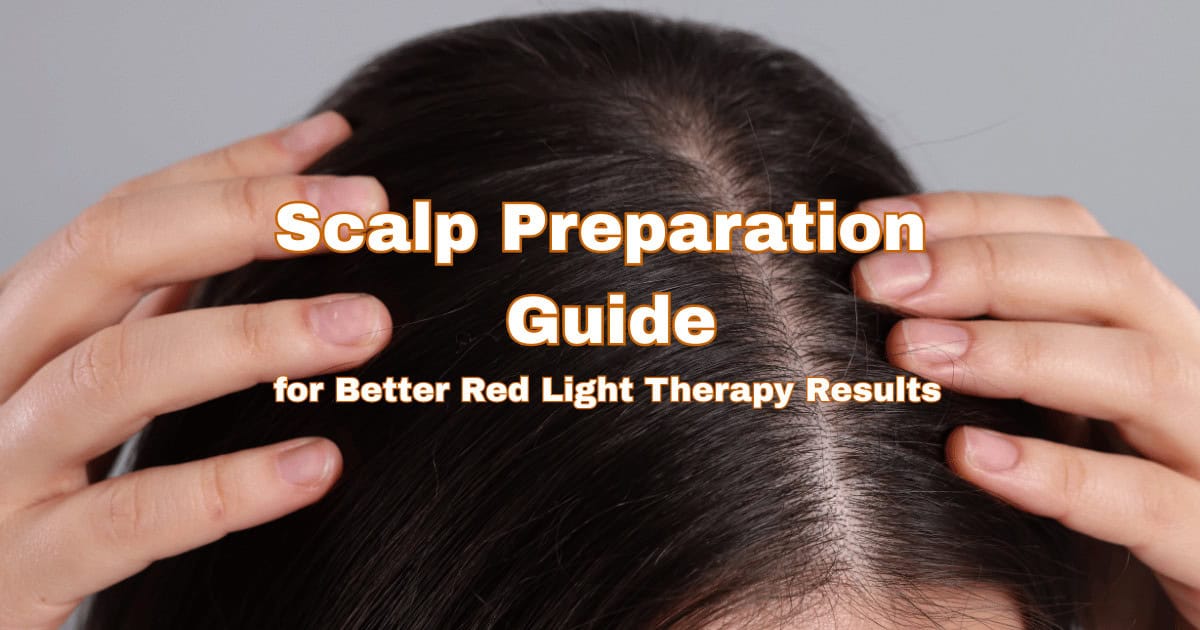
If red light therapy (RLT) sessions are consistent but results feel muted, the scalp may be blocking more light than expected. Oils, product film, dense hair, inflammation, and poor contact can scatter or absorb photons before they reach follicle cells.
This guide shows how to prep the scalp so more light lands where it matters—then how to keep that advantage session after session. [1][2]
Why scalp prep matters
- Light must reach the skin. Hair, oil, and residue reflect and scatter light; clean skin with parted hair reduces loss and improves delivery to follicles. Reviews and clinical reports consistently tie outcomes to actual scalp dose, not device brightness. [1][2]
- Inflammation blunts response. Irritated or over‑oily scalps can be less responsive; calmer skin and balanced sebum support better comfort and adherence over months. [3][4]
- Small prep wins compound. A few minutes of prep can save 10–15 minutes of session time or reduce the urge to “overdo” duration to compensate. [5]
The 5‑minute pre‑session routine
1) Wash or wipe to “zero residue”
- Aim for a clean, dry scalp. If it’s a non‑wash day, use a gentle, residue‑free wipe or a quick rinse to remove oils and styling film. [5]
- Avoid leave‑in occlusives before treatment (heavy oils, waxes, thick creams). Apply nutrients or styling after the session. [1]
2) Create clear part lines
- Use a rat‑tail comb to part in straight, evenly spaced rows (1–2 cm apart). Focus on target zones (vertex, mid‑scalp, hairline). [2]
- Keep parts open with clips or the comb itself so light sees skin, not hair. [2]
3) Optimize contact and distance
- For caps/helmets: Ensure a snug, stable fit; briefly reposition mid‑session to even coverage across curves. [2]
- For combs/brushes: Glide slowly with gentle contact along each part; count seconds per row to avoid rushing. [1]
- For panels/wands: Stay close and perpendicular; set a fixed spacer if possible for repeatable distance. [5]
4) Control angles across curves
- Rotate the device slightly around the vertex and parietal ridges to minimize shadows. Two to three positions per zone beat one long, static angle. [2]
5) Keep the skin calm
- If the scalp is reactive, use a mild, non‑occlusive moisturizer after washing and before fully drying; let it absorb, then treat on dry skin. [3]
- Skip harsh scrubs immediately before sessions; gentle exfoliation belongs on off‑days. [5]
Weekly maintenance that improves penetration
A simple weekly routine keeps the scalp surface clear so light can reach its target. Clarify once a week with a gentle chelating or clarifying shampoo to lift residual product and mineral film that accumulates even with careful habits.
On non‑wash days, a soft brush‑through helps lift micro‑flakes and distribute natural oils in a thin layer rather than allowing a heavy film to build. If a cap or helmet is part of the setup, launder or replace liners and pads regularly; oil‑soaked fabrics increase scattering and compromise hygiene.
Seasons matter as well: humidity raises sweat and oil, while cold, dry air increases flaking and irritation. Adjust wash cadence and post‑wash moisturization to match conditions, and consider broader routine timing shifts as outlined in Seasonal Adjustments: Optimizing Red Light Therapy Year‑Round.
Prep adjustments for common scalp scenarios
For oily scalps or frequent buildup, plan sessions after a quick wash or rinse on heavier‑oil days, and choose lightweight, rinse‑clean conditioners. Reserve occlusive stylers until after treatment to avoid creating a barrier.
When the scalp is dry, flaky, or sensitive, use a mild, fragrance‑free shampoo, pat dry, and give skin 10–15 minutes to settle before exposure. A light moisturizer immediately after washing can improve comfort; begin treatment once it has absorbed and the surface is dry.
With dense or coarse hair, create narrower parts and slow the pace along each row, especially when using contact combs or brushes. If using a panel, add a second angle pass so light reaches through hair from two directions.
Device‑specific prep tips
Caps and helmets work best on a dry, parted scalp with gentle downward pressure to minimize lift and gaps. A small mid‑session micro‑shift—rotating the cap by roughly 10–15 degrees—helps even out dose on curved regions like the vertex.
Combs and brushes should glide at a “one Mississippi” pace along each part; repeat a pass over very dense areas, and periodically wipe device tips to remove oil film that scatters light.
Panels and wands benefit from a simple spacer (about 2–3 cm) that fixes distance for repeatable irradiance; keep the device perpendicular to the scalp and treat each zone from two angles to reduce shadows at the crown and sides.
Don’t let “overdoing it” replace good prep
Extending time to compensate for poor prep can backfire. Aim to improve delivery first (clean skin, parting, contact, angles), then set duration. If irritation or paradoxical shedding follows aggressive changes, scale back time and rebuild with better prep. [1]
For dose‑related warning signs, see: Overdoing Red Light Therapy: Signs You’re Using It Too Much.
Pair prep with device verification (fast checklist)
- Output reality check: Confirm the device emits consistently and strongly enough at your real distance. A quick pass/fail helps separate device issues from prep problems. See: Is Your Red Light Device Actually Working? Testing Power and Wavelength. [2]
- Coverage audit: Photograph the scalp in good light after parting; note any zones that are hard to expose and plan extra angles or a contact pass there. [2]
- Time math: If prep is solid yet sessions are still long, adjust distance (safely closer), angles, or consider a targeted upgrade rather than endlessly adding minutes. [1]
A simple pre/post routine you can stick to
- On treatment days
- Quick wash or residue‑removing wipe; pat fully dry. [5]
- Part rows; treat each part with close, perpendicular delivery. [2]
- Post‑session: Apply leave‑ins, actives, or styling as desired. [5]
- On non‑treatment days
- Gentle brush‑through; moisturize if dry; keep scalp calm. [3]
- One clarifying wash weekly to reset. [5]
Track whether prep is working
- Photos every 4 weeks, same light and angles, with the same parting pattern. [2]
- Notes on session time, any irritation, and whether angles/parting reduced shadowing. [2]
- Watch for earlier signs: less tightness/itch post‑session, more even warmth, shorter sessions to reach targets. For a simple measurement and photo protocol, see: Progress Tracking: Measuring Red Light Hair Growth Success Accurately. [2]
When to get medical help
- Persistent redness, burning, or pain with or without treatment suggests dermatitis or infection that merits evaluation. Treating underlying inflammation first often improves comfort and response. [3][4]
- Sudden diffuse shedding or scaly plaques need diagnosis; prep alone won’t overcome active scalp disease. Coordinate care, then resume RLT with a calmer foundation.
For more information, see our guide: Red Light Therapy Not Working? Complete Troubleshooting Guide for Hair Growth
Bottom line
Better scalp prep increases the fraction of light that reaches follicle cells, letting shorter, more comfortable sessions do more work. Clean, dry skin, clear part lines, close/perpendicular delivery, and calm scalp biology add up to measurable improvements—without changing the device.
Start small, make prep repeatable, and log changes so wins accumulate over the next 12–24 weeks. [2][1]
FAQ
What problems can block red light from reaching follicles that the article doesn’t cover in depth?
Beyond oil and hair scattering, residue from hard water minerals, silicone-based conditioners, and dry-shampoo starches can form microfilms that reflect or absorb photons before they hit the skin surface, reducing effective dose despite session length.
How can someone tell if poor prep—rather than the device—is limiting results?
Do a same‑day A/B: one session after a clarifying wash with tight parting and perpendicular contact versus a typical session; if time-to-target warmth and post‑session comfort improve with the prepped side, prep—not hardware—is the bottleneck.
What quick tools make parting easier on dense or curly hair?
Use a rat‑tail comb plus small sectioning clips; a light water mist and a touch of leave‑in applied after sessions (never before) helps parts stay open without adding pre‑treatment occlusion that could scatter light.
How should sensitive or inflamed scalps adjust timing around sessions?
Keep pre‑wash gentle and allow 10–15 minutes after towel‑drying for the barrier to settle, then treat on fully dry skin; moisturizers should be non‑occlusive and used post‑wash but fully absorbed before exposure to avoid photon loss and irritation.
What weekly habits maintain better light penetration without daily washing?
Schedule one chelating or clarifying shampoo per week to lift mineral and product film, brush lightly on off‑days to lift flakes, and launder cap liners so oil doesn’t build into a light‑scattering interface over time.
How close is “close enough” without overdoing time?
Use a repeatable spacer for panels to fix distance and keep angles perpendicular; if sessions still run long with solid prep, adjust angles or consider targeted hardware changes rather than extending duration, which can increase irritation risk.
What signs show prep is working in under a month?
Expect faster, more even warmth at the scalp, less tightness or itch after sessions, and shorter time needed to reach the usual target feeling; document with identical-angle photos every 4 weeks using the same parting pattern for objective comparison.
How can cap or helmet users avoid shadowing on curved areas?
Confirm hair is dry and parted, ensure a snug fit to reduce lift, and add a small mid‑session rotation so the vertex and parietal curves receive a more even dose across positions.
What should be cleaned besides the scalp to reduce scattering?
Wipe contact comb/brush tips and panel surfaces regularly to remove oils and film, and wash or replace helmet liners; even thin residue layers can change incident light angles and reduce delivery.
When is it time to pause RLT and see a clinician?
Persistent burning, redness, pain, scaly plaques, or sudden diffuse shedding indicate possible dermatitis or infection; treating the underlying condition first restores comfort and responsiveness before resuming light sessions.
How can results be tracked without special equipment?
Use a simple protocol: same lighting, distance, and angle photos every 4 weeks, note session duration, irritation, and whether new angles or parting reduced shadows; this ties prep changes to measurable outcomes over 12–24 weeks.
What’s a stick-to-it routine that avoids overlap with the article’s steps?
Think cadence, not checklists: pre‑treat days focus on residue removal and consistent spacing; off‑days focus on film control (clarify weekly, brush lightly), liner hygiene, and notes so incremental prep wins compound without extending exposure time.
References
1) Red Light Man. Complete guide to light therapy dosing (accessed 2025). https://redlightman.com/blog/complete-guide-light-therapy-dosing/
2) Stanford Medicine. Red light therapy: What the science says (2025). https://med.stanford.edu/news/insights/2025/02/red-light-therapy-skin-hair-medical-clinics.html
3) National Eczema Association. Seborrheic Dermatitis: Causes, Symptoms, Treatment (2025). https://nationaleczema.org/types-of-eczema/seborrheic-dermatitis/
4) Verywell Health. The Link Between Seborrheic Dermatitis and Hair Loss (2024). https://www.verywellhealth.com/seborrheic-dermatitis-hair-loss-5185124
5) Bestqool. Scalp Rejuvenation | Red Light Therapy Guide (2024). https://www.bestqool.com/blogs/news/red-light-therapy-scalp-benefits