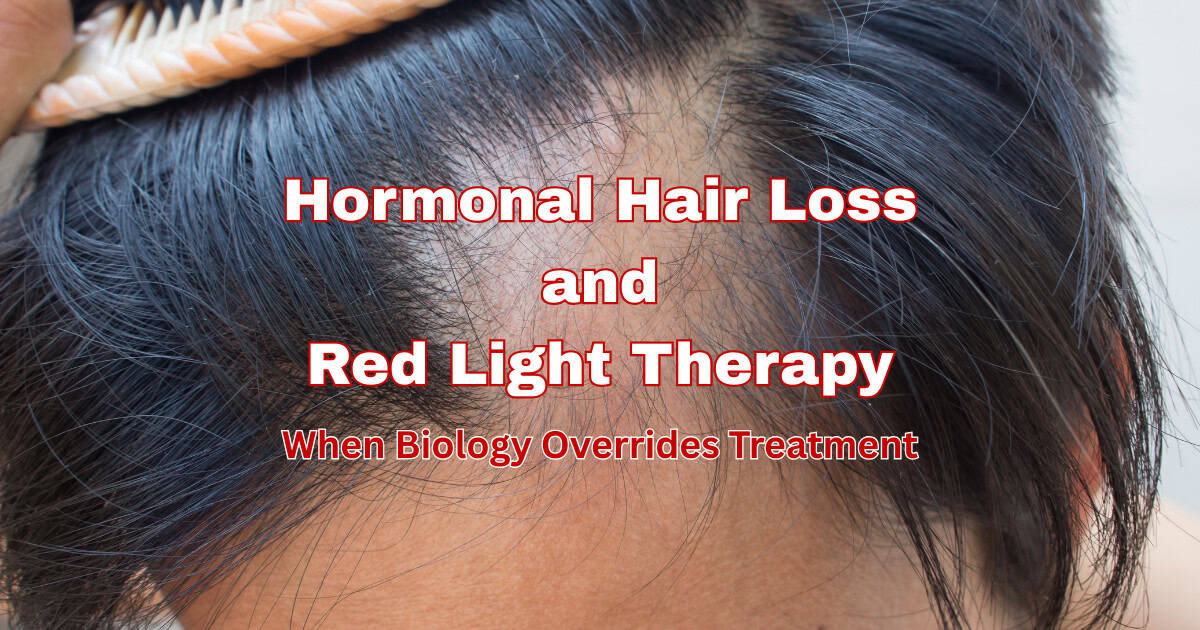
Red light therapy (RLT) can support follicle energy and signaling, but it does not switch off androgen-driven miniaturization or menopausal signaling changes.
When biology dominates—via dihydrotestosterone (DHT), androgen receptor activity, or estrogen decline—results can plateau unless the hormonal drivers are addressed in parallel.
This article explains how to recognize hormonal headwinds, how to run RLT intelligently alongside medical care, and when to escalate beyond home routines.
Key Takeaways
- Androgenetic alopecia shortens anagen and miniaturizes follicles through DHT and androgen receptor signaling; RLT doesn’t neutralize that signal. Pairing with hormonal strategies is often required. [3][4]
- In perimenopause/menopause, estrogen decline alters follicle metabolism and cycling; timelines lengthen and combination plans matter more. [5][6]
- Judge RLT on 12–24‑week trends with standardized tracking; if delivery is verified and biology still dominates, escalate care rather than “doing more minutes.” [2][7]
How hormones overpower a good light routine
In androgenetic alopecia (male and female pattern hair loss), local DHT production, 5α‑reductase activity, and abundant androgen receptors in susceptible scalp zones progressively shorten anagen and thin shafts. The result is a higher telogen ratio and stepwise miniaturization, especially along the frontal/vertex pattern in men and central thinning in women.
This signal keeps pressing until it is modulated pharmacologically or hormonally; RLT can support dermal papilla and matrix activity, but cannot countermand sustained androgen drive on its own. [3][4]
Menopause adds a different layer. Falling estrogen and shifting receptor sensitivity change follicle energy handling and vascular/metabolic support. Many women notice diffuse thinning or textural changes, while a subset develops classic female‑pattern loss.
Here again, RLT can aid cellular energy and signaling, but the macro‑signal dictates the ceiling on results unless hormonal context is addressed. [5][6]
What RLT can and cannot do under hormonal pressure
RLT supports mitochondrial function and pro‑growth signaling in dermal papilla cells and can improve density and diameter over 12–24 weeks when delivery is consistent. Trials and syntheses across combs, caps, and helmets show benefit under defined regimens.
However, effect sizes vary, and entrenched miniaturization or active androgen excess often require combination strategies to convert signaling gains into visible coverage. Expect RLT to help with caliber and possibly density in viable follicles; do not expect reversal where follicles are severely miniaturized without addressing the driver. [2][7][8]
A staged plan when hormones are the bottleneck
First, verify delivery. Hold distance steady with a spacer or tape marks, keep the device perpendicular, part hair into 1–2 cm rows, and use two to three angles over the vertex and parietal curves. Convert measured or validated irradiance into time, and keep the same positions each session. Track monthly photos and, if possible, a 1 cm² “count box” to see direction despite slow change. This ensures any plateau is biological—not a hidden delivery problem. [2]
Second, screen for endocrine clues. Patterned progression despite verified delivery, a family history of early patterning, postpartum or perimenopausal timing, or signs of androgen excess in women (e.g., acne, irregular cycles) point to hormonal dominance. Diffuse thinning after stress, illness, or medication shift may be telogen effluvium; that deserves timeline mapping before changing therapy. Distinguishing these patterns focuses the plan. [3][5][6]
Third, pair intelligently. For men with clear patterning, discuss DHT‑targeting strategies (e.g., 5α‑reductase inhibition) and adjuncts, while maintaining RLT for caliber support and scalp comfort. For women, topical minoxidil remains foundational; where hyperandrogenism is likely, clinicians may consider antiandrogenic approaches, with RLT supporting caliber and tolerance. Perimenopausal or postmenopausal patients often benefit from longer horizons, meticulous positioning, and combination therapies determined with a clinician. [6][9]
Fourth, set realistic timelines. Make the first efficacy judgment at 12 weeks for stabilization and early caliber changes, and the primary call at 24 weeks with side‑by‑side photos and the count‑box trend. If delivery is verified and biology remains dominant at 24 weeks, escalate the hormonal plan rather than extending RLT time indefinitely. [2][7]
When biology clearly wins—and what to do next
Certain signals indicate that hormonal drivers or long‑standing miniaturization are limiting RLT’s ceiling:
- Progressive patterning on standardized photos despite verified, comfortable delivery and adherence across 24 weeks.
- Central thinning in women around perimenopause/menopause that does not stabilize with good routines alone.
- Early‑onset, rapidly advancing male‑pattern loss with strong family history and visible miniaturization under trichoscopy.
In these scenarios, preserve what RLT contributes (comfort, caliber support, adherence rituals) but let the hormonal plan lead. Coordinate with a clinician to tailor endocrine management, then retain RLT as a supportive layer that helps follicles translate the improved hormonal environment into better growth. [3][5][6]
Practical guidance to keep gains while hormones are addressed
Maintain a “comfort‑first” routine so adherence stays high while medical therapy begins to work. Treat on clean, dry skin; part consistently; keep two to three angles; and avoid compensating with longer sessions that risk irritation. Log weekly shed trends and monthly photos to show stabilization before density catches up. If sensitive scalp or dermatitis flares overlap perimenopause or therapy changes, calm the scalp first; inflamed skin tolerates less and hides progress. [2]
Expect synergy to be gradual. As androgen pressure lightens or estrogen support improves, follicles need cycles to thicken shafts and fill coverage. This is why 12–24‑week windows matter, especially in later decades. If, after combination therapy, progress remains flat and logistics become burdensome, consider a professional program to optimize parameters or explore procedural options appropriate to pattern and stage. See: Age and Red Light Therapy: Why Results Vary by Life Stage and Professional Red Light Therapy When Home Treatment Fails. [6][7]
Conclusion
RLT is a valuable support for viable follicles, but it cannot neutralize androgen drive or menopausal signaling by itself. When biology wins, the answer isn’t “more minutes”—it’s a combined plan that puts endocrine management in front and lets RLT do what it does best: support caliber, comfort, and consistency while the real driver is treated.
Assess objectively at 12 and 24 weeks, adjust based on evidence, and escalate medical care when the plateau reflects hormones, not technique. [1][2]
For the full diagnostic ladder that keeps device, technique, and biology aligned, start here: Red Light Therapy Not Working? Complete Troubleshooting Guide for Hair Growth.
FAQ
What are early clues that hormones are limiting results from red light therapy?
Pattern-consistent thinning (frontal/vertex in men; central/diffuse in women), visible miniaturization on trichoscopy, and continued progression over 12–24 weeks despite verified delivery suggest androgen signaling is dominant. Family history and perimenopausal timing strengthen suspicion of hormonal drivers. These patterns align with DHT/androgen receptor activity shortening anagen and miniaturizing follicles.
How long should red light therapy be trialed before changing the plan?
Make an initial check at 12 weeks for stabilization and shaft caliber changes, then a primary call at 24 weeks using standardized photos and, ideally, a 1 cm² count area. Clinical trials and syntheses commonly report measurable changes within 12–26 weeks under defined regimens. If delivery is verified and progression continues at 24 weeks, prioritize endocrine management over “more minutes.”
What does “verified delivery” actually mean for home devices?
Keep the device perpendicular at a fixed distance, part hair into consistent rows, cover the vertex/parietal curves from two to three angles, and derive time from measured or validated irradiance. Consistency allows confidence that any plateau reflects biology rather than technique. Controlled trials that demonstrate benefit rely on standardized, repeatable dosing and coverage.
Can red light therapy reverse long‑standing miniaturization on its own?
No. RLT can support mitochondrial function and pro‑growth signaling in viable follicles, improving density/diameter in trials, but it does not neutralize DHT or menopausal signaling by itself; entrenched miniaturization typically needs combination therapy to convert signaling gains into visible coverage. Expect caliber support more than full reversal without addressing the driver.
What combination strategies are commonly paired with red light therapy?
For androgenetic alopecia, clinicians frequently combine antiandrogen approaches (e.g., 5‑alpha‑reductase inhibition) and minoxidil, with RLT supporting caliber and tolerance. Low‑dose oral minoxidil is increasingly used, and antiandrogens are core in male AGA; female care may incorporate antiandrogenic strategies when hyperandrogenism is suspected.
How does menopause change expectations and timelines?
Estrogen decline and shifts in follicle metabolic/vascular support can lengthen timelines and reduce the ceiling for monotherapy. Many experience diffuse thinning or textural change; outcomes improve when metabolic/hormonal context is addressed alongside RLT, with tracking over 12–24 weeks to capture gradual synergy.
When should escalation to medical care take precedence over tweaking home routines?
If standardized photos show continued pattern progression at 24 weeks despite correct dosing and coverage, or if perimenopausal/menopausal thinning fails to stabilize with consistent routines, escalate endocrine management and keep RLT as a supportive layer rather than the lead intervention.
Is treatment frequency more important than total time?
Meta-analytic data suggest that lower-frequency regimens can perform as well or better than higher-frequency schedules, provided dosing is consistent and adequate. Quality and consistency of delivery matter more than simply adding extra minutes.
What’s the realistic “best case” for red light therapy under hormonal pressure?
The most reliable benefits are improved shaft caliber and incremental density in responsive follicles, contributing to coverage when paired with effective hormonal or pharmacologic control; effect sizes are clinically meaningful in trials but vary by device, adherence, and biology. Maintain realistic goals and use objective tracking to verify gains.
Key takeaway for strategy
Let the hormonal plan lead when pattern progression persists, keep RLT for caliber/comfort/adherence, and make calls at 12 and 24 weeks using standardized evidence rather than extending sessions indefinitely.
References
1) JCAD. A Systematic Review and Meta‑analysis of Randomized Controlled Trials of LLLT for hair loss (trial windows; efficacy context). https://jcadonline.com/laser-therapy-hair-loss/
2) Hair growth promotion by photobiomodulation therapy using home-use devices (evidence synthesis and regimen windows). https://www.jkslms.or.kr/journal/view.html?uid=305&vmd=Full
3) StatPearls: Androgenetic Alopecia (2024 update) – DHT, androgen receptor signaling, miniaturization, anagen shortening. https://www.ncbi.nlm.nih.gov/books/NBK430924/
4) Androgenetic Alopecia: Pathogenesis overview (2024–2025 reviews) – 5α‑reductase, androgen receptor abundance in susceptible scalp zones. https://www.scirp.org/journal/paperinformation?paperid=133926
5) The Menopausal Transition and Hair Follicle Changes – estrogen decline, metabolic/vascular effects, texture/density shifts. https://pmc.ncbi.nlm.nih.gov/articles/PMC10669803/
6) Effects of Hormones and Endocrine Disorders on Hair Growth – female pattern hair loss, androgen excess, perimenopausal considerations. https://pmc.ncbi.nlm.nih.gov/articles/PMC9788837/
7) Umbrella/controlled data on PBM timelines and perceived outcomes (12–26 weeks) – interpretation by life stage. https://pmc.ncbi.nlm.nih.gov/articles/PMC12326686/
8) Effects of photobiomodulation on hair dermal papilla cells – mechanistic support for mitochondrial and signaling modulation. https://www.sciencedirect.com/science/article/pii/S1011134424002409
9) FPHL and androgen-excess management considerations (clinical report). https://academic.oup.com/jcem/article/104/7/2875/5342938